The Rugby Gym Workout: Lifts, Sets and Reps That Transfer
Strength & Conditioning · 7 July 2026 · 13 min read
 With Phil Healey · S&C Coach
Starting at USD$0.82 USD$0.49/day when billed annually. Save 40%.

Your fitness should intimidate as much as your skillset.
The conditioning stack
Every session type, on tap.
On the field
 Pitch Fitness26 sessions · 12 to 48 min
 Hill Fitness11 sessions · 18 to 38 min
 Speed & Sprint12 sessions · 17 to 36 min
 Running6 sessions · 15 to 35 min
Off your feet
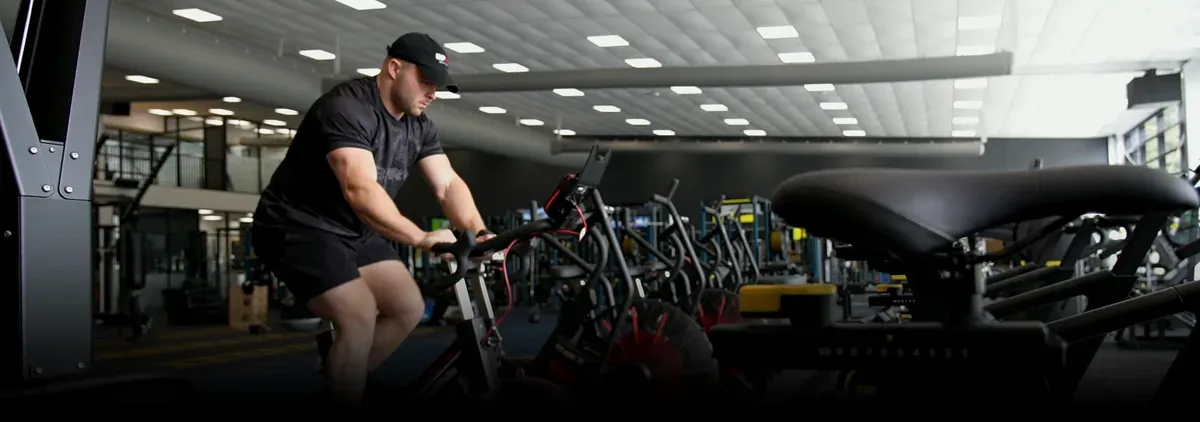 Bike16 sessions · 12 to 40 min
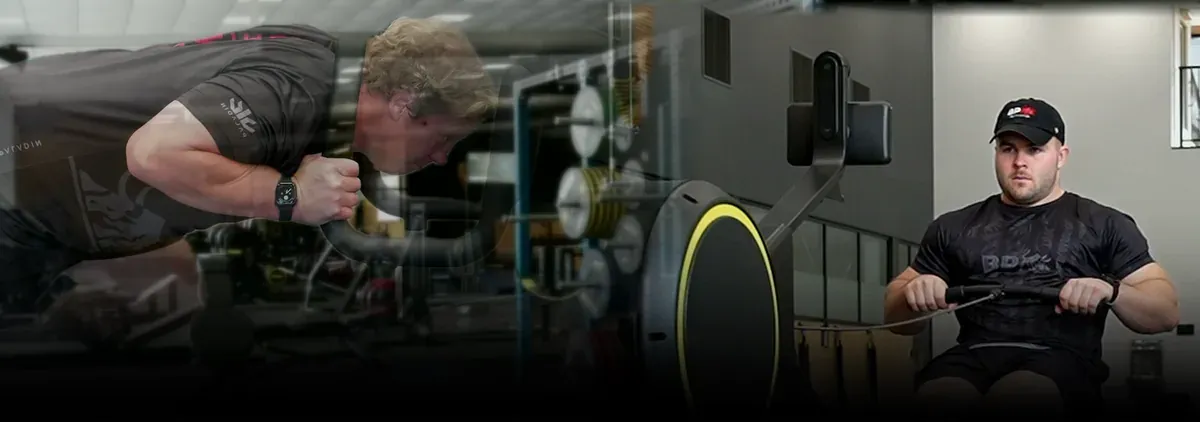 Rower24 sessions · 12 to 54 min
A rugby gym program is a position-specific strength plan built on four movements — a push, a pull, a hinge and a carry — lifted two to four times a week around matches. Front rows load the hinge and the push. Outside backs load speed and single-leg work. The lifts, sets, reps and weekly split are below.
What lifts should a rugby player do?
A rugby player should train four movements every week: a push, a pull, a hinge and a carry. We call them the Four Lifts That Decide a Season, because everything a forward does in a scrum and everything a back does in the first three steps is one of them under load. Add the squat, add neck and trunk, and the list is finished.
1. Push
Bench press and overhead press. The fend, the wrap, the wrestle and the lineout lift are all pressing patterns, and pressing is the half of the upper body that keeps a shoulder healthy when the pulling gets heavy.
2. Pull
Weighted chin-ups, rows, and Nordic hamstring curls as the insurance policy. Pulling is the jackal, the counter-ruck and the tackle you finish rather than bounce off. Keep it in balance with the push, week in and week out.
3. Hinge
Trap-bar deadlift, Romanian deadlift and hip thrust, with the back squat as the knee-dominant twin that loads the same drive. This is the collision block: the hips are where a scrum, a carry and a sprint all start.
4. Carry
Farmer’s carries, front-rack carries, sled and partner drags. A carry loads the trunk and the grip while you are moving, which is the only way to train the thing that actually holds a body shape together in contact.
Neck and trunk work sits underneath all four, every single week. It is not optional in a collision sport — the same argument the durability programs are built on.
| Lift | Sets × reps | Why a rugby player does it | Position it matters most for |
|---|---|---|---|
| Trap-bar deadlift | 4 × 5 | Builds the hip and back strength every collision and every scrum starts from, in a bar position most big players can hold safely. | Front Row (1, 2, 3) |
| Back squat | 4 × 5 | Leg drive through contact, out of the first step, and in the scrum and the maul. | Locks (4, 5) |
| Hip thrust | 4 × 5 | The most direct transfer to sprint power and to driving the legs through a tackle rather than stopping in it. | Outside Backs (11, 14, 15) |
| Bench press | 4 × 5 | The fend, the wrap and the wrestle — pressing strength is what finishes a tackle instead of bouncing off one. | Inside Backs (12, 13) |
| Weighted chin-up | 4 × 5 | Pulling strength for the jackal and the counter-ruck, and the balance that keeps a shoulder healthy under a pressing load. | Flankers (6, 7) and No. 8 |
| Overhead press | 4 × 5 | Lineout lifting, contact height, and shoulders that are still there in March. | Locks (4, 5) |
| Farmer's carry | 3 × 40 m | Trunk and grip under load, which is what holds a body shape together in contact and in the tackle. | Front Row (1, 2, 3) |
| Nordic hamstring curl | 3 × 5 | The one accessory nobody who sprints should skip, because the hamstring is where a fast player's season ends. | Halfbacks (9, 10) |
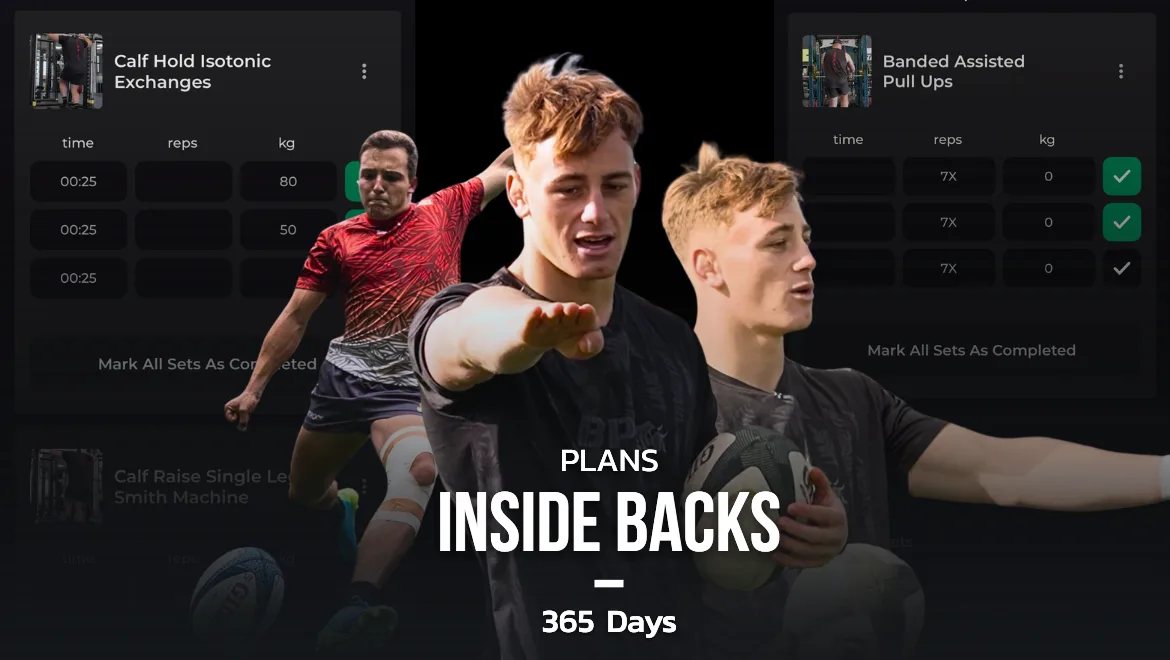
Built for your position.
Answer a few questions and see the programs for your position, then train them in the app.





Read the full guide
How many days a week should a rugby player be in the gym?
A rugby player should be in the gym two days a week in season and three to four out of season. In-season, most players get two quality sessions and a third only in a light fixture week. The split that survives contact training:
- Day 1 (early week): lower-body strength + power. Trap-bar or squat focus, hip thrust, jumps. Farthest from the match, so legs recover.
- Day 2 (mid-week): upper-body strength + neck/trunk. Press and pull paired, direct neck work, carries.
- Optional Day 3 (48h+ before kick-off): fast and light. Low-volume power, primers, nothing that leaves soreness.
Off-season flips the emphasis: three to four sessions, more volume, and a proper progression from hypertrophy to max strength to power, laid out phase by phase in the rugby pre-season gym program.
What does a full rugby gym week look like?
A full rugby gym week in season is two gym days around two team trainings and a Saturday match. Out of season it is four gym days, a speed day between them and two full rest days. Both weeks are written out below with every lift, set and rep, at four sets of five, the dose for a player one to three years into lifting.
In season, around a Saturday match
| Day | Session | Lifts, sets and reps | Time |
|---|---|---|---|
| Monday | Gym and speed | Lower-body max strength, then short acceleration workBack squat, Romanian deadlift, hip thrust: 4 × 5.Sprints from a standing start: 8 × 30 m. | 75 min |
| Tuesday | Team | Main pitch session: skills and defence while fresh, conditioned game at the end | 90 min |
| Wednesday | Gym | Upper-body strength, neck and trunk. Low leg loadBench press, weighted chin-up, overhead press: 4 × 5.Then neck and trunk work. | 60 min |
| Thursday | Team and skills | Team run: structure, lineouts, strike plays, plus a few fast strides | 60 min |
| Friday | Rest | Rest | Off |
| Saturday | Match | Match | 80 min |
| Sunday | Recovery | Off feet: walk, pool, sleep | 30–45 min |
Off-season: four gym days and two rest days
| Day | Session | Lifts, sets and reps | Time |
|---|---|---|---|
| Monday | Gym | Lower-body strength: squat, hinge and hip thrustBack squat, Romanian deadlift, hip thrust: 4 × 5. | 60 min |
| Tuesday | Gym | Upper-body strength, neck and trunkBench press, weighted chin-up, overhead press: 4 × 5.Then neck and trunk work. | 60 min |
| Wednesday | Speed and conditioning | Speed while you are fresh, then a small-sided conditioning game with the ballSprints from a standing start: 8 × 30 m. | 60 min |
| Thursday | Rest | Rest | Off |
| Friday | Gym | Lower body again: trap-bar deadlift, hip thrust and a heavy carryTrap-bar deadlift, hip thrust: 4 × 5.Farmer's carry: 3 × 40 m. | 60 min |
| Saturday | Gym and conditioning | Upper body again, then aerobic conditioning that climbs week by weekOverhead press, weighted chin-up, bench press: 4 × 5.Then neck and trunk work.Keep it aerobic: add a little each week, never all in week one. | 75 min |
| Sunday | Rest | Rest | Off |
For your own position, part of the season and number of training days, the free rugby training programme builder turns these into your week, and it prints.
How should a beginner start a rugby gym program?
A beginner should start with two or three full-body sessions a week, a day apart, built on the same four movements every rugby player trains: a push, a pull, a hinge and a carry. Three sets of ten at a weight you could lift a few more times. The first block is for making every rep look the same, not for finding your maximum.
| Session | Main lifts | Sets × reps | To finish |
|---|---|---|---|
| Full body A | Trap-bar deadlift, bench press, chin-up | 3 × 10 | Farmer's carry, 3 × 40 m |
| Full body B | Back squat, overhead press, row | 3 × 10 | Nordic hamstring curl, 3 × 5 |
Add weight only when every set looks like the first one, and change one thing at a time. Once the lifts hold their shape, move to four sets of five, which is the dose the full weeks above are written at. In season, a beginner runs the same lower-body and upper-body days as the in-season week above, at three sets of ten, so mid-week stays light on the legs.
How long should a rugby gym session be?
A rugby gym session should last 40 to 75 minutes. The heavy lower-body day with its sprint work is the long one, at about 75 minutes. An upper-body day is about an hour, a gym day in a two-match week drops to 40 or 50 minutes, and a primer before a match takes 10 to 15. The heaviest session of the week is the longest, and the closer the match, the shorter the session.
| Session | How long | When |
|---|---|---|
| Heavy lower-body day, with sprint work after it | 75 min | Monday in season and in pre-season |
| Upper body, neck and trunk | 60 min | Mid-week in season, and the off-season upper days |
| Full-body session | 60 min | Beginners, and anyone training three days a week |
| Gym day in a two-match week | 40 to 50 min | The one heavy day, and the upper-body day with no leg load |
| Primer before a match | 10 to 15 min | The day before, or 48 hours out in a two-match week |
How does a rugby gym program change by position?
A rugby gym program changes by position in emphasis, not in structure. Every position pushes, pulls, hinges and carries; what moves is how heavy, how fast, and where the extra work goes.
Front row and tight five
Maximal strength is the priority: heavy hinge and squat variations, pressing strength, heavy carries, and more direct neck volume than any other position. Repeat-effort conditioning lives on the pitch, not in the gym; the gym is where the scrum is built.
Back row and midfield
The collision positions with a running problem: they need near-tight-five strength at a body weight they can carry for 80 minutes. Priority on power output, contrast pairs (heavy lift into jump or throw), and trunk strength for the jackal and the double-hit.
Halves and outside backs
Speed is the product; the gym serves it. Force at speed (jumps, hip thrusts, lighter faster lifts), hamstring insurance work every week, and enough upper-body strength to finish tackles and fend, without chasing bench numbers a winger will never use. This is the same emphasis a pro rugby player workout runs at international level.
Do forwards and backs need different lifts?
Forwards and backs need the same lifts with different lead lifts. Every position pushes, pulls, hinges and carries. Forwards chase heavier numbers for the scrum, the maul and the collision, and the centres sit closest to them. The halves and the back three move lighter loads faster and look after their hamstrings every week, because speed is what their gym serves.
| What changes | Forwards (1 to 8) | Backs (9 to 15) |
|---|---|---|
| Lead lifts | Trap-bar deadlift, back squat, weighted chin-up, overhead press, farmer's carry | Hip thrust, bench press, nordic hamstring curl |
| What the gym builds | Maximal strength for the scrum and the maul, neck strength, power in contact | Force at speed, strength to fend and finish a tackle, hamstrings that last the season |
| Speed work | Short accelerations; the front row does the least top-speed running | Acceleration and change of direction for the halves, top-end speed for the back three |
| Every week | Direct neck work, heaviest for the front row | Nordic hamstring curls |
How do you add weight without burning out mid-season?
- Progress one variable at a time: load, sets or density, not all three at once.
- Deload every third or fourth week, or the season will schedule one for you as an injury.
- Anchor to the calendar: the same week should never look identical in October and in March. In-season lifting maintains and sharpens; off-season lifting builds.
- Fuel it: a gym program without a food plan is half a program, see our nutrition system.
Where does the gym fit in a rugby week?
The gym is one of five claims on a rugby week, alongside conditioning, skills, team sessions and recovery. How to place them so they add up instead of cancelling out is the subject of the rugby training program, which sets out an in-season, an off-season and a pre-season template.
This guide is the lifting half of the job. Which day those lifts land on, what the speed and conditioning days do around them, and how the emphasis changes for each position group are all set out in the four-week rugby workout plan, which also hands out a per-position PDF.
To print the lifting on paper, the free rugby workout plan PDF writes four weeks out for all six position groups. To print one week built around your own fixtures, use the rugby training programme builder.
Or skip the assembly entirely: ERA’s gym programs are periodised across a full 365-day season cycle and built per position, with every session laid out, coached, and adjusted to your calendar.
Made with Phil Healey
Phil HealeyRugby union strength and conditioning coachPhil Healey is a New Zealand rugby union strength and conditioning coach whose record runs from Counties Manukau and the Chiefs to Glasgow Warriors, the Blues and the Kobe Steelers. Phil is Elite Rugby App's head of programming.
- Counties Manukau 2003-2008
- Chiefs 2008-2017
- Glasgow Warriors 2017-2018
- Blues
- Kobe Steelers
- New Zealand head of performance from 2026
Frequently asked questions
What is a good rugby gym program for beginners?
A good rugby gym program for beginners is two or three full-body sessions a week built on a push, a pull, a hinge and a carry, at three sets of ten with a weight you could lift a few more times. Learn the lifts first, add load one step at a time, and keep at least a day between sessions.
Should rugby players lift heavy in season?
Rugby players should keep lifting heavy in season, but less often and with less volume. One heavy lower-body day early in the week holds most of the strength built in the off-season, as long as nothing heavy lands inside 48 hours of kick-off. The aim is to arrive fresh on Saturday, not to set records.
What is the best gym split for rugby?
The best gym split for rugby is lower body early in the week and upper body mid-week, with a light, fast session only when the fixture allows. Out of season it becomes two lower and two upper days. A bodybuilding split that trains one muscle group a day leaves no room for speed, conditioning or team training.
How many sets and reps should a rugby player do?
A rugby player should do three to five sets of three to ten reps on the main lifts, depending on the week. Three sets of ten builds a base, four sets of five builds strength, and five sets of three, moved fast, builds power. New lifters stay at three sets of ten until the lifts look the same every rep.
Do backs need to lift as heavy as forwards?
Backs do not need to lift as heavy as forwards, but they do need to be strong. They train the same push, pull, hinge and carry, with more of the work moved fast: jumps, hip thrusts and lighter, quicker lifts, plus hamstring work every week. Front rows chase the heaviest numbers because the scrum asks for them.
Is there a free rugby gym program?
Yes, there is a free rugby gym program on this page: the lifts, the sets and reps, an in-season and an off-season gym week, and a beginner's version. The free plan builder turns it into a full week for your position, and the rugby workout plan PDF writes out four weeks for all six position groups.
Do rugby players lift weights?
Rugby players do lift weights, and at every level above social rugby it is a fixed part of the week. Two quality gym sessions is the in-season baseline and three or four the off-season one. The lifts are few and heavy — a push, a pull, a hinge and a carry — because the pitch already supplies the variety.
Do rugby players deadlift?
Rugby players deadlift, most often from a trap bar rather than a straight bar. The trap bar puts the load beside you instead of in front of you, which lets a big player drive the hips hard without hunting for a back position, and it is far easier to coach across a whole squad at once.
How many times a week do rugby players weight train?
Rugby players weight train two to four times a week, and the number moves with the season. In season it is two quality sessions, three in a light fixture week. Out of season it climbs to three or four, because there is no Saturday to arrive fresh for and the point is to build.
How to fit weight training around rugby?
You fit weight training around rugby by putting the heaviest session furthest from the match. In a Saturday-match week that means a heavy lower-body day on Monday or Tuesday, a lighter power session mid-week, and nothing heavy inside 48 hours of kick-off. The match is the priority; the gym is what makes it survivable.
Is rugby good for weight loss?
Rugby is good for weight loss, but it is a poor way to plan for it. Training and match play burn a great deal, yet the load is dictated by the fixture list rather than by your waistline. Players who change body composition do it by changing what they eat around the same sessions.
What is the 3-3-3 rule gym?
The 3-3-3 rule in the gym is usually taken to mean three sets of three reps on three main lifts, run at a heavy load. It is a simple strength template rather than a rugby-specific one — useful inside a build block, but it does no speed, conditioning or contact work, so it cannot be a whole rugby programme.
The whole week it would sit inside is the four-week rugby workout plan.
What is the 40/20 rule in rugby?
There is no 40/20 rule in rugby union — 40/20 is a rugby league rule, where a kick from inside your own 40-metre zone that bounces into touch inside the opposition 20 wins the scrum feed. Union’s equivalent is the 50:22: kick from your own half, bounce it into touch inside their 22, and you throw in to the lineout.
How much should a 6-2 rugby player weigh?
A 6'2" rugby player's weight depends on the position they play. At international level a 6'2" outside back and a 6'2" prop can be thirty kilos apart, so the figure worth chasing is the one your own position asks for, moved deliberately in a block rather than by accident.
Measured bands per unit are in rugby positions by body type.
How many hours a day do rugby players train?
Professional rugby players commonly train around four to six hours a day across gym, pitch and recovery, split into two or three sessions. That is a full-time job. A club or school player training four times a week is doing the same shape of work at a fraction of the volume, which is the right comparison.
The day-by-day version is in how professional rugby players train.
Train it, don’t just read it
Every session in this guide is built, periodised and coached inside Elite Rugby App, from the strength staff behind international and Super Rugby teams.
Weighing it up? Read how Elite Rugby App compares with other rugby training apps.