Your Rugby Workout: Today's Session, Then Four Weeks
Strength & Conditioning · 7 September 2026 · 11 min read
 With Phil Healey · S&C Coach
Starting at USD$0.82 USD$0.49/day when billed annually. Save 40%.


Your fitness should intimidate as much as your skillset.
The conditioning stack
Every session type, on tap.
On the field
 Pitch Fitness26 sessions · 12 to 48 min
 Hill Fitness11 sessions · 18 to 38 min
 Speed & Sprint12 sessions · 17 to 36 min
 Running6 sessions · 15 to 35 min
Off your feet
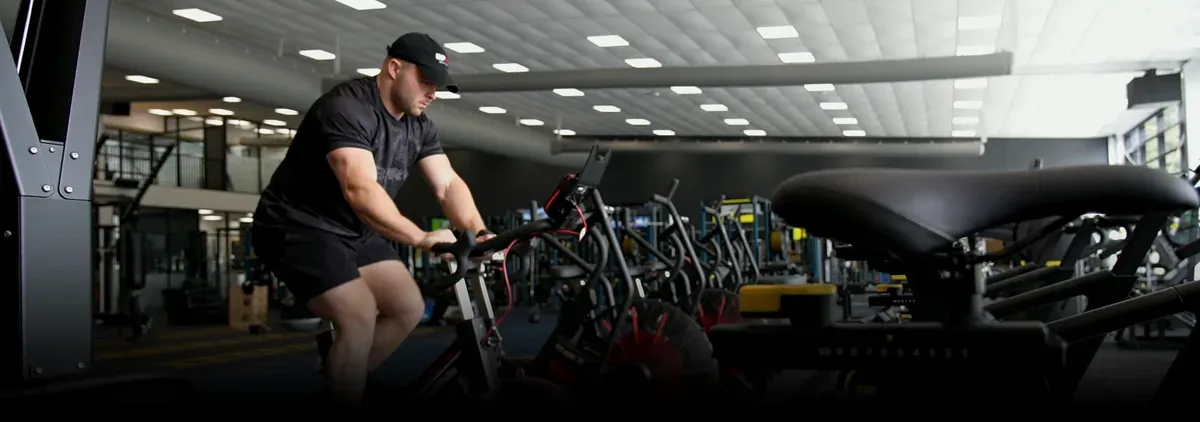 Bike16 sessions · 12 to 40 min
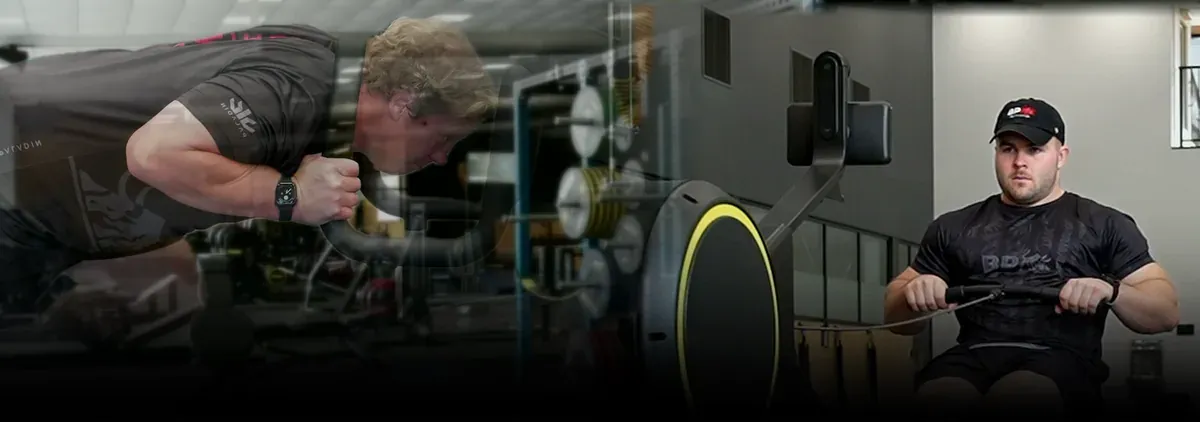 Rower24 sessions · 12 to 54 min
A good rugby workout is one gym session that trains power, strength and your engine together, in that order, in about an hour. Below is one complete session you can do today, then the four-week plan it comes from: lift heavy twice a week, sprint fresh once, condition twice, and change the emphasis by position. The free per-position PDF gives you all four weeks written out.
A complete rugby workout you can do today
If you have one gym session this week, do this one. It takes the main lift from each of the plan’s two gym days, puts the fast work first while you are fresh, and finishes with the kind of repeat effort a match asks for. Lift heavy but clean: when a rep slows to a grind, the set is over.
| Part | Exercise | Sets × reps | Rest | Why |
|---|---|---|---|---|
| Warm-up | Skips, leg swings, 2 × 10 pogo hops and three build-up runs over 20 m | 10 minutes | None | The same warm-up as the power workouts, so the jumps that follow start fast |
| Power | Box jump: jump up, land soft and quiet, step down | 4 × 3 | 90 seconds | Fast work goes first, while you are fresh |
| Strength 1 | Back squat | 4 × 5 | 2 to 3 minutes | The Week 2 squat: leg strength for the scrum, the ruck and the first few metres |
| Strength 2 | Bench press | 4 × 5 | 2 to 3 minutes | The Week 2 press: upper-body strength for contact |
| Pair | Romanian deadlift, then weighted chin-up | 4 × 5 of each | 90 seconds after each pair | Week 2's hinge and pull, done back to back to save time |
| Carry, neck and trunk | Farmer's carry, then your neck and trunk work | 3 × 40 m | 90 seconds | Trunk and grip under load, which is what holds a body shape together in contact and in the tackle |
| Finisher | 40/20 repeats: sprint 40 m, jog back 20, go again on a 30-second cycle | 1 set of 6 | Built into the cycle | The closest a running drill gets to the rhythm of phase play |
Front-row forwards: add direct neck work; the farmer’s carry matters most for you. Backs: swap the 40/20 repeats for six 30 m sprints from a standing start with a walk back, the plan’s Tuesday speed work, because your job is speed into space. The power part is the same for everyone; the moves and doses behind it are in rugby power training.
Built for your position.
Answer a few questions and see the programs for your position, then train them in the app.





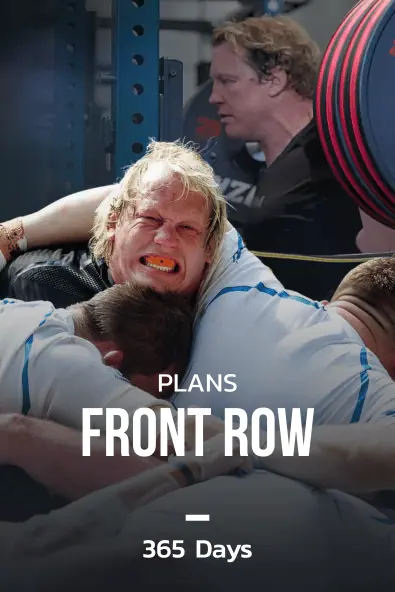

Read the full guide
What is the ERA Four-Block Build?
The ERA Four-Block Build is four weeks that each do one job, run in order. Repeating the same week for a month is the most common mistake in a self-written plan: the body adapts to it within a few weeks and then holds still.
- Week 1 — BASE. Volume, movement quality and work capacity. Reps are high, load is moderate, and nothing is chased.
- Week 2 — BUILD. Load goes up and reps come down. This is the week that makes you stronger.
- Week 3 — POWER. Speed of the bar and speed of the feet. Weight comes off so the bar can move; the set ends when it slows. The moves, doses and tests behind this week are in rugby power training.
- Week 4 — PEAK. Deload, then test and retest, so you finish the block with a number rather than a feeling.
Four weeks is one block, and a season is made of them. Inside Elite Rugby App the same logic runs across a 365-day cycle with four phases: Off-Season (Week 1–8), Pre-Season (Week 17–24), In-Season (Week 33–40) and Active Rest (Week 49–52). Run this block where it fits your own calendar, then keep running blocks.

What does a rugby workout week actually look like?
A rugby workout week is four sessions: two in the gym, one speed session run fresh, and one conditioning session. The table below is the whole four-week block, week by week, so you can see what changes and what stays the same.
| Block | Day | Focus | Main lifts | Sets × reps |
|---|---|---|---|---|
| 1 · BASE | Monday | Lower-body strength | Back squat, Romanian deadlift, hip thrust | 3 × 10 |
| 1 · BASE | Tuesday | Speed fresh, then conditioning | Sprints from a standing start, then a small-sided game | 6 × 30 m, walk back |
| 1 · BASE | Thursday | Upper body, neck and trunk | Bench press, weighted chin-up, overhead press, neck and trunk | 3 × 10 |
| 1 · BASE | Friday | Repeat-sprint conditioning | Shuttles, or a conditioning game that looks like the match | 2 × 8 × 40 m |
| 2 · BUILD | Monday | Lower-body max strength | Back squat, Romanian deadlift, hip thrust | 4 × 5 |
| 2 · BUILD | Tuesday | Speed fresh, then conditioning | Sprints from a standing start, then a small-sided game | 8 × 30 m |
| 2 · BUILD | Thursday | Upper body, neck and trunk | Bench press, weighted chin-up, overhead press, neck and trunk | 4 × 5 |
| 2 · BUILD | Friday | Repeat-sprint conditioning | Shuttles, or a conditioning game that looks like the match | 3 × 6 × 40 m |
| 3 · POWER | Monday | Lower body, moved fast | Back squat, trap-bar jumps, hip thrust | 5 × 3, bar speed not load |
| 3 · POWER | Tuesday | Top-end speed | Flying sprints off a rolling start, then footwork | 6 × 40 m flying |
| 3 · POWER | Thursday | Upper body, neck and trunk | Bench press, med-ball throws, weighted chin-up, neck and trunk | 5 × 3 |
| 3 · POWER | Friday | Short, sharp conditioning | Shuttles, or a conditioning game that looks like the match | 4 × 5 × 40 m |
| 4 · PEAK | Monday | Deload, then retest | Back squat, hip thrust, then retest the squat | 2 × 5, then retest |
| 4 · PEAK | Tuesday | Timed speed | Sprints, timed over the same distance as week 1 | 4 × 30 m, timed |
| 4 · PEAK | Thursday | Upper body, neck and trunk | Bench press, weighted chin-up, neck and trunk | 2 × 5 |
| 4 · PEAK | Friday | Play, or trial | A game, a trial, or a full-contact session | Match load |
Wednesday and the weekend are deliberately empty. If you have a match, it replaces Friday; if you have a team session, it replaces the conditioning day rather than sitting on top of it. Adding sessions to a full week is how players arrive at round one already tired — how the whole training week fits together is a question of its own.
How many days a week should a rugby player train in the gym?
A rugby player should train in the gym two to three days a week in season, and three to four out of season. Two heavy days done properly beat four rushed ones, and the gym is only one of the stresses in the week: pitch sessions, conditioning and the match itself all draw on the same recovery.
The plan above uses two gym days so the speed day can be run fresh. If you are out of season and want a third, add it midweek and keep it light. Eat for the work as well — what you eat around training decides how much of the session you actually keep.
What lifts belong in a rugby workout plan?
A rugby workout plan needs a squat, a hinge, a press, a pull, a hip thrust and power work — plus neck and trunk every single week, which is non-optional in a collision sport. That is a short list on purpose: six or seven movements, loaded properly, beat twenty done at half effort.
The sets, reps, progressions and position variations for each of those lifts are the subject of their own guide, and repeating them here would only make both worse. Read the lifts, sets and reps behind each session for the detail; this page is the week they sit inside.
How does a rugby workout plan change by position?
A rugby workout plan changes by position in emphasis, not in structure: every position squats, presses, sprints and conditions, and what moves is where the extra work goes. Elite Rugby App programmes six position groups, and the table below is what each one leans into.
| Position group | Shirts | What the plan emphasises | What it dials down |
|---|---|---|---|
| Front Row | 1, 2, 3 | Scrum power and neck strength, loosehead / tighthead position-specific lifts, and an off-season hypertrophy block. | Max-velocity sprint volume. |
| Locks | 4, 5 | Maul drive and lifting strength, lineout aerial conditioning, and a pre-season volume block. | Repeated change-of-direction work. |
| Flankers | 6, 7, 8 | Breakdown power and repeat efforts, tackle-collision conditioning, and open / blindside / No. 8 splits. | Single heavy efforts with long rests. |
| Halfbacks | 9, 10 | Acceleration and change-of-direction, kicking-leg conditioning, and decision-making under fatigue. | Upper-body mass for its own sake. |
| Inside Backs | 12, 13 | Collision strength and fend work, hand-off and ball-carry conditioning, and 12 / 13 position-specific splits. | Long, slow aerobic volume. |
| Outside Backs | 11, 14, 15 | Top-end speed and sprint mechanics, aerial-contest conditioning, and evasive footwork power. | Grinding high-rep lifting. |
If you are not sure which group you belong in, work back from your own height, weight and pace: find the position your body suits first, then take the row above. The full position-specific programmes live in the position-specific gym programs inside the app.
Can you do a rugby workout plan at home or with no equipment?
You can run this plan at home, and you will keep the engine while losing some of the strength. Sprints, hills, press-ups, chin-ups on anything solid, single-leg squats, sled or partner drags and hard trunk work all transfer. Keep the four-day shape and the block order; substitute the loaded lifts, not the sprinting.
What no-equipment training cannot replace is heavy loading, and heavy loading is what prepares you for contact. Treat a home block as the bridge to a gym block, not a permanent swap, and build the aerobic base while you are there with the conditioning blocks that build the engine.
Download the rugby workout plan PDF for your position
The rugby workout plan PDF is the same four-week block as the table above, written out for all six position groups — sixteen sessions each, the same two gym days, speed day and conditioning day, with the sets and reps beside them and each group’s own programme lines listed on its page. The cover says plainly that it is a sample block rather than the full programme. It is ten pages, and it prints.
Get the plan as a PDF for your position
Four weeks, four sessions a week, written out for all six position groups. We’ll add you to the list, and the download link is right here, nothing to wait for.
By clicking “Get the PDF”, and sharing your email, you agree to our Terms of Service and Privacy Policy.
Or download it straight away: Rugby Workout Plan — 4-Week Block by Position (PDF), no email needed.
When in the season should you run this plan?
Run this plan when you have four uninterrupted weeks and no fixture you are protecting: the back end of the off-season, or the opening month of pre-season. In season, keep the same four days but hold week 2 as the standing week, because the match is already supplying the peak.
Eight weeks out from round one, this block is the first half of a longer runway — the eight-week pre-season build is where it leads. If you want to see what the professional version of the same week looks like, we wrote how professional rugby players train from the inside.
Why am I fit in the gym but gassed on the pitch?
You are fit in the gym but gassed on the pitch because gym fitness is paced and rugby fitness is not. A machine or a circuit lets you settle into a rhythm; a match gives you a maximal effort, twelve seconds of walking, another maximal effort, and a scrum you have to push in while still breathing hard from the last one.
The fix is not more running. It is repeat-sprint work with short, incomplete rest, done at a speed you could not hold for five minutes, plus enough contact conditioning that the collisions themselves stop costing you a set of lungs. That is what the Friday session in the table above is for, and it is why it is written as shuttles or a conditioning game rather than a steady run.
The second half of the answer is strength. A player who is strong enough for the collisions spends less of their engine surviving them, which is the least obvious reason the two heavy gym days in this plan are non-negotiable.
How do I plan my gym week if I play twice a week?
If you play twice a week you get one heavy gym day, not two, and the rest of the week is primers and recovery. With a midweek fixture and a weekend one there is no day sitting 48 hours clear of both matches, so the honest version of this week has a single heavy exposure early and protects everything else.
| Day | Session | Focus |
|---|---|---|
| Monday | Lower-body strength, 50 min | The one heavy day: hinge, squat, hip thrust. Furthest from Saturday |
| Tuesday | Primer, 15 min | Light power and a few strides. Nothing that leaves soreness |
| Wednesday | Match | The midweek fixture |
| Thursday | Upper body, neck and trunk, 40 min | Press and pull paired. No leg load at all |
| Friday | Team run or skills, 45 min | Structure and handling, plus a few fast strides |
| Saturday | Match | The weekend fixture |
| Sunday | Off feet | Walk, pool, sleep. This is the session that makes the week work |
Hold this shape for as long as the double-fixture block lasts, then go back to the four-day week above. Strength is maintained on one heavy day a week for a surprisingly long time; it is only building that needs two. Where the rest of the week’s work goes once the fixtures thin out is the rugby training program.
Where to find out more
The strength and conditioning material behind this plan is standard practice rather than anything proprietary, and the governing body publishes its own free coaching and player-welfare resources at World Rugby and World Rugby Passport. On this site, the next steps are the gym program itself, conditioning that looks like the game and the coaches behind these programmes.
Frequently asked questions
What is a good workout routine for rugby?
A good workout routine for rugby is four sessions a week: two heavy gym days, one speed day run fresh, and one conditioning day. Keep the lifts few and heavy, put the sprinting before the fatigue rather than after it, and change the emphasis every week instead of repeating the same session for a month.
How long should a rugby workout take?
A rugby gym workout takes about an hour. The one on this page is a ten-minute warm-up, then a power move, four main lifts, a carry with your neck and trunk work, and a short running finisher. Keep the lifts few and heavy, and stop a set when the bar slows to a grind.
Should rugby players do cardio in the gym?
Rugby players should do most of their fitness work on the pitch, because a match is repeated sprints with short rests. This page's plan puts conditioning in its own sessions on Tuesday and Friday, as shuttles or a conditioning game that looks like the match. In the gym, a short finisher after the lifts, like the 40/20 repeats in the session above, is enough.
What is the best rugby workout for forwards and for backs?
Forwards and backs do the same main lifts. Front-row forwards add direct neck work, and the trap-bar deadlift and the farmer's carry matter most for them; backs swap the running finisher for sprints from a standing start with a walk back, because their job is speed into space. The position table on this page sets out the difference for all six groups.
What is the 3-3-3 rule gym?
The 3-3-3 rule in the gym is usually taken to mean three sets of three reps on three main lifts, run at a heavy load. It is a simple strength template rather than a rugby-specific one — useful inside a build block, but it does no speed, conditioning or contact work, so it cannot be a whole rugby programme.
What is the 40/20 rule in rugby?
There is no 40/20 rule in rugby union — 40/20 is a rugby league rule, where a kick from inside your own 40-metre zone that bounces into touch inside the opposition 20 wins the scrum feed. Union’s equivalent is the 50:22: kick from your own half, bounce it into touch inside their 22, and you throw in to the lineout.
Is 5'9" too short for rugby?
5'9" is not too short for rugby. Across eight of the squads at the 2023 World Cup, scrum-halves ran from 165 cm and fly-halves from 174 cm, so being under six foot rules out the second row and little else. Selection turns on your engine and your work in contact.
How much should a 6-2 rugby player weigh?
A 6'2" rugby player's weight depends on the position they play. At international level a 6'2" outside back and a 6'2" prop can be thirty kilos apart, so the figure worth chasing is the one your own position asks for, moved deliberately in a block rather than by accident.
Measured bands per unit are in rugby positions by body type.
How many hours a day do rugby players train?
Professional rugby players commonly train around four to six hours a day across gym, pitch and recovery, split into two or three sessions. That is a full-time job. A club or school player training four times a week is doing the same shape of work at a fraction of the volume, which is the right comparison.
What to eat 3 hours before a rugby match?
Three hours before a rugby match you want a familiar carbohydrate-based meal with some protein, little fat, little fibre, and a drink alongside it. Top it up with something small and fast about an hour before kick-off if you need to. Match day is the wrong day to try a new food.
What is the toughest position in rugby?
The toughest position in rugby is usually said to be tighthead prop, because the scrum loads one side of the body for eighty minutes and there is nowhere to hide in it. Openside flanker and hooker are the other two answers, both for workload across the game.
All fifteen shirts are compared in rugby positions and numbers.
Is there a rugby workout plan PDF?
Yes — there is a free rugby workout plan PDF on this page. It carries the same four-week block written out for all six position groups, sixteen sessions each, with the sets and reps beside them. You can download it without giving an email if you would rather not.
Can you do a rugby workout with no equipment?
You can do a rugby workout with no equipment, and it will build your engine faster than your strength. Bodyweight and hill work carry the conditioning side of the block, and the four-day shape still holds. What it cannot replace is heavy loading, which is what prepares you for contact.
Train it, don’t just read it
Every session in this guide is built, periodised and coached inside Elite Rugby App, from the strength staff behind international and Super Rugby teams.
Weighing it up? Read how Elite Rugby App compares with other rugby training apps.