
Your Rugby Training Programme, Week by Week
Strength & Conditioning · 7 July 2026 · 12 min read
 With Phil Healey · S&C Coach
Starting at USD$0.82 USD$0.49/day when billed annually. Save 40%.


Your fitness should intimidate as much as your skillset.
The conditioning stack
Every session type, on tap.
On the field
 Pitch Fitness26 sessions · 12 to 48 min
 Hill Fitness11 sessions · 18 to 38 min
 Speed & Sprint12 sessions · 17 to 36 min
 Running6 sessions · 15 to 35 min
Off your feet
 Bike16 sessions · 12 to 40 min
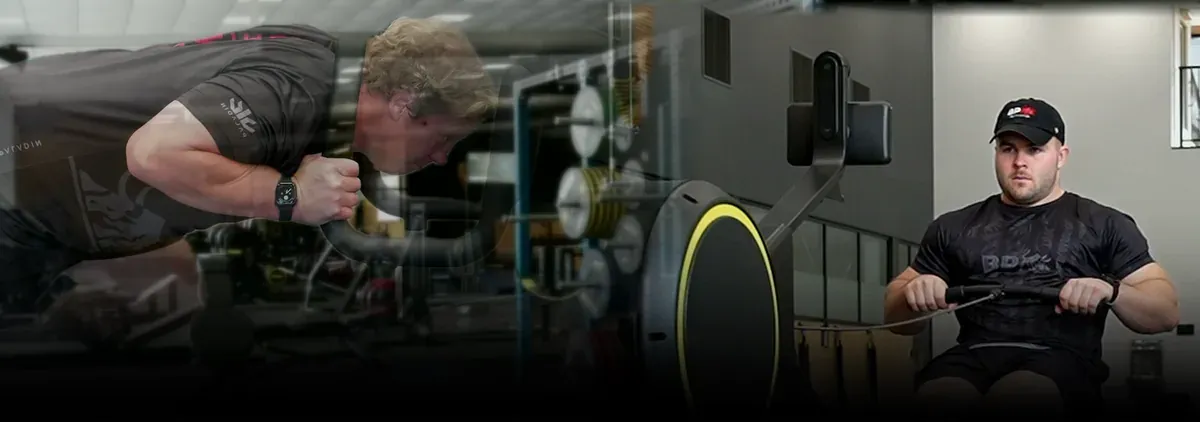 Rower24 sessions · 12 to 54 min
A rugby training program is a weekly plan that fits five claims on your time — gym, conditioning, skills, team training and recovery — around one match. In-season the match sets the week. Off-season the gym does. Pre-season is the bridge between them. The templates for all three are below.
Build your rugby training programme
Choose your position, the part of the season you are in, the days you can train and how long you have been lifting. The week below changes as you choose. It is built from the same templates as every table on this page, and it prints.
| Day | Session | What to do | Time |
|---|---|---|---|
| Monday | Gym and speed | Lower-body max strength, then short acceleration workBack squat, Romanian deadlift, hip thrust: 4 × 5.Sprints from a standing start: 8 × 30 m.Back row: the weighted chin-up matters most for you, with trunk work for the jackal. | 75 min |
| Tuesday | Team | Main pitch session: skills and defence while fresh, conditioned game at the end | 90 min |
| Wednesday | Gym | Upper-body strength, neck and trunk. Low leg loadBench press, weighted chin-up, overhead press: 4 × 5.Then neck and trunk work. | 60 min |
| Thursday | Team and skills | Team run: structure, lineouts, strike plays, plus a few fast strides | 60 min |
| Friday | Rest | Rest | Off |
| Saturday | Match | Match | 80 min |
| Sunday | Recovery | Off feet: walk, pool, sleep | 30–45 min |
- Flankers (6, 7, 8)
- In the app, the Flankers program leans into breakdown power and repeat efforts, tackle-collision conditioning, and open / blindside / No. 8 splits. Spend less of the week on single heavy efforts with long rests.From our team: Kieran Read, 127 caps for New Zealand, 2008-2019; Peter Lakai, first capped by New Zealand in 2024; Du'Plessis Kirifi, first capped by New Zealand in 2025.
- In-season
- Hold what you built and arrive fresh on Saturday. Maintain, do not chase.
- 1 to 3 years in the gym
- Four sets of five: the load goes up and the reps come down. Every rep should look like the first.
Made with Phil Healey, Elite Rugby App's head of programming.Counties Manukau 2003-2008, Chiefs 2008-2017, Glasgow Warriors 2017-2018, Blues, Kobe Steelers, New Zealand head of performance from 2026Built for your position.
Answer a few questions and see the programs for your position, then train them in the app.








Read the full guide
What has to fit into a rugby training week?
Five things compete for a rugby training week, and the match is the frame they all fit inside rather than a sixth claim. We call them the Five Claims on Your Week, and every scheduling argument you will ever have is about which of them gives way.
- Gym. Strength and power, two to three sessions. What goes in them is the rugby gym workout.
- Conditioning. The engine, and the speed work that must be run fresh rather than tacked onto the end of a session. In-season it is maintained, not built.
- Skills. Passing, kicking and handling, little and often, while you are fresh enough to learn something.
- Team. Units, defence and structure. Non-negotiable in time and place, because it is not yours to move.
- Recovery. Sleep, food and the days you do nothing. The adaptation happens here, not in the sessions.
What is the difference between off-season, pre-season and in-season rugby training?
The difference between off-season, pre-season and in-season rugby training is what the week is protecting. Off-season protects nothing, so it builds. Pre-season protects round one, so it converts strength into power and reintroduces contact. In-season protects Saturday, so it maintains. The volumes move; the movements do not.
| Phase | Weeks | Focus | Sessions per week |
|---|---|---|---|
| Off-Season | Week 1–8 | Build strength and size. There is no match to protect, so build | 4 gym · 2 conditioning |
| Pre-Season | Week 17–24 | Turn strength into power, running into repeat-sprint work, and reintroduce contact | 3 gym · 3 conditioning |
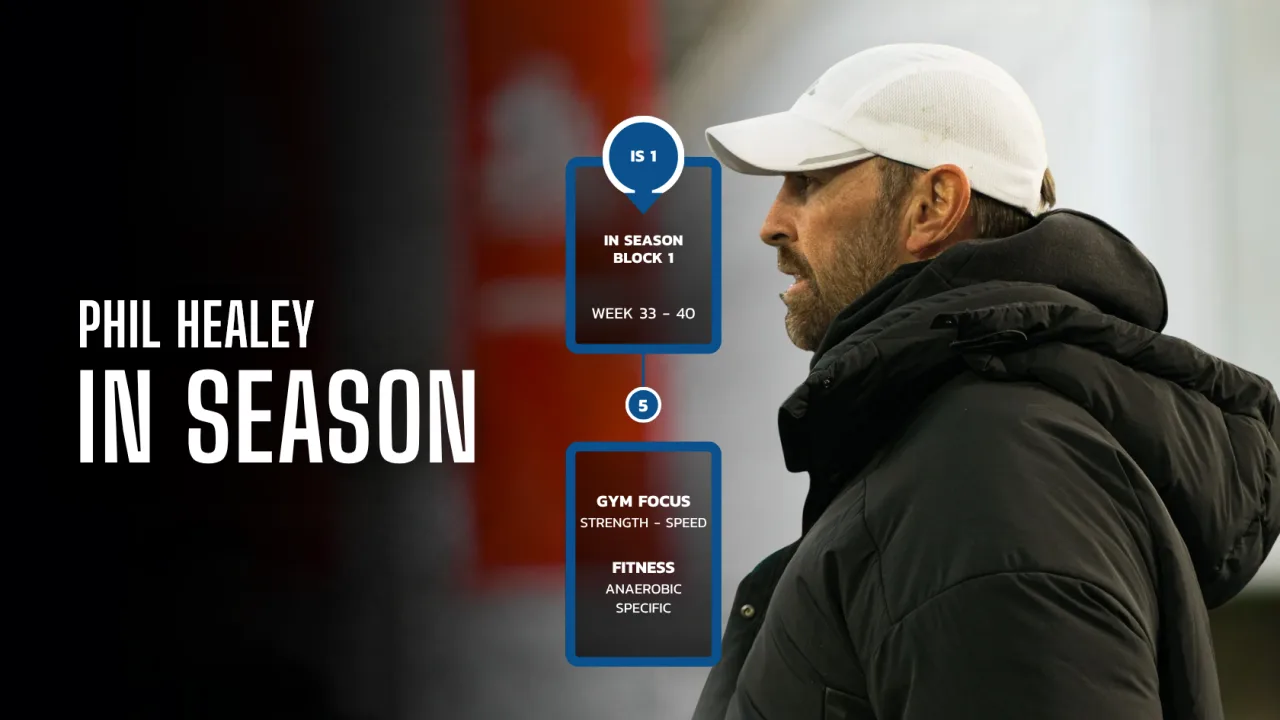
| In-Season | Week 33–40 | Hold what you built and arrive fresh on Saturday. Maintain, do not chase | 2 gym · 1 conditioning · 2 team |
| Active Rest | Week 49–52 | Tempo work and aerobic base. Rebuild without losing what you built | 1 gym · 1 easy aerobic |
The gaps between the blocks are deliberate: weeks 9–16 and 25–32 are where a real calendar puts tours, exams and holidays, and weeks 41–48 are the back half of a long season, when you are holding on rather than building. If you want the four-week version of one of these blocks, written out session by session, it is the rugby workout plan.
When is the rugby off-season, pre-season and in-season?
The rugby off-season is May to June in the northern hemisphere and November to January in the southern. Pre-season follows it, in July and August up north and February and March down south, and the in-season runs September to April in the north and April to July in the south. Find the month you are in below, then pick the matching week in the builder.
| Month | North (UK, Ireland, France) | South (New Zealand, Australia, South Africa) |
|---|---|---|
| January | In-season | Off-season |
| February | In-season | Pre-season |
| March | In-season | Pre-season |
| April | In-season | In-season |
| May | Active rest, then off-season | In-season |
| June | Off-season | In-season |
| July | Pre-season | In-season |
| August | Pre-season | Active rest |
| September | In-season | Active rest |
| October | In-season | Active rest |
| November | In-season | Off-season |
| December | In-season | Off-season |
The month table comes from World Rugby’s Rugby Ready guidance on physical conditioning. One thing it makes plain: in the north the in-season is eight months long, so the in-season week below is the one a northern club player runs for most of the year.
What does an in-season rugby week look like?
An in-season rugby week is built backwards from the match: heavy early, fast late, and nothing punishing inside 48 hours of kick-off. The template below assumes a Saturday fixture.
| Day | Session | Duration | Priority |
|---|---|---|---|
| Monday | Lower-body max strength, then short acceleration work | 75 min | Gym |
| Tuesday | Main pitch session: skills and defence while fresh, conditioned game at the end | 90 min | Team |
| Wednesday | Upper-body strength, neck and trunk. Low leg load | 60 min | Gym |
| Thursday | Team run: structure, lineouts, strike plays, plus a few fast strides | 60 min | Skills |
| Friday | Rest, or a ten-minute primer of light power work | 0–10 min | Recovery |
| Saturday | Match | 80 min | The match |
| Sunday | Off feet: walk, pool, sleep | 30–45 min | Recovery |
The two rules hiding in that template: hard days are genuinely hard and easy days are genuinely easy, and nothing slow and exhausting happens within 48 hours of kick-off. Drills and session shape are in our rugby drills guide.
What does an off-season rugby week look like?
An off-season rugby week is four gym sessions, two conditioning sessions, one dedicated speed day and at least two full rest days. No match means you can finally build. Two lower-body days, two upper, an aerobic base that climbs gradually rather than all in week one, and ball in hand at least once so the skills do not rust.
| Day | Session | Duration | Priority |
|---|---|---|---|
| Monday | Lower-body strength: squat, hinge and hip thrust | 60 min | Gym |
| Tuesday | Upper-body strength, neck and trunk | 60 min | Gym |
| Wednesday | Speed while you are fresh, then a small-sided conditioning game with the ball | 60 min | Conditioning |
| Thursday | Rest | Off | Recovery |
| Friday | Lower body again: trap-bar deadlift, hip thrust and a heavy carry | 60 min | Gym |
| Saturday | Upper body again, then aerobic conditioning that climbs week by week | 75 min | Gym |
| Sunday | Rest | Off | Recovery |
This is the block where ERA’s fitness work does its heaviest lifting, because a base built now is what you maintain for the next nine months.
How is a pre-season week different?
A pre-season week is different because it converts: strength becomes power, running becomes repeat-sprint conditioning, and contact is reintroduced progressively rather than on the first Tuesday. It is its own subject, with a phase-by-phase plan and a sample week, in the rugby pre-season gym program.
How do you adapt the template to your level?
The plan builder at the top of this page does this for you: it takes the weeks above and fits them to your position, your days and your time in the gym. The rules it follows are these.
If you can only train three days a week
Combine, do not cut. In season your two team trainings stay, and the third day is one full-body gym session on Monday, as far from Saturday as the week allows. Out of season it is full-body gym on Monday and Friday with a speed and conditioning session between them. Quality over spread.
If you play two matches a week
The week becomes recover, prime, play, recover, prime, play. One short gym exposure to hold strength; everything else is freshness.
If you are new to the gym
In your first year of lifting, run three sets of ten at a weight you could lift a few more times, keep at least a day between gym sessions, and spend the spare day on the ball. The lifts and the two full-body sessions are in the rugby gym program for beginners.
By age and level
Younger players need more skill exposure and less specialised conditioning; senior amateurs need more recovery discipline than they think and less junk volume than they do. The structure is the same; the ratios move.
What breaks a rugby training week?
- Conditioning on speed day. Tired sprinting trains you to be slow.
- Heavy legs on Thursday or Friday. You will feel it at kick-off.
- Skipping the easy days. The adaptation happens in the gaps, not the sessions.
- Training through everything. Niggles flagged early cost a week; hidden ones cost a season. Build the armour with durability work and fuel it with a real nutrition plan.
The done-for-you version
This whole structure, the gym, the conditioning phases, the speed work and the recovery, is what Elite Rugby App programs lay out across a 365-day season cycle, per position, with every session laid out and coached. You pick your position and your calendar; the week arranges itself.
Made with Phil Healey
Phil HealeyRugby union strength and conditioning coachPhil Healey is a New Zealand rugby union strength and conditioning coach whose record runs from Counties Manukau and the Chiefs to Glasgow Warriors, the Blues and the Kobe Steelers. Phil is Elite Rugby App's head of programming.
- Counties Manukau 2003-2008
- Chiefs 2008-2017
- Glasgow Warriors 2017-2018
- Blues
- Kobe Steelers
- New Zealand head of performance from 2026
Frequently asked questions
What is a good rugby training programme?
A good rugby training programme is built around your match, your position and the part of the season you are in. It names every day: two or three gym sessions, one speed session run fresh, conditioning that looks like the game, skills, and real rest. It changes with each phase instead of repeating the same week all year.
How many days a week should I train for rugby?
Most club players should train four or five days a week for rugby, counting team sessions, plus the match. In season that is two gym days and two team trainings around a Saturday game. Off-season it is four or five days, with at least two full rest days. Three days still works if you combine sessions instead of cutting them.
What should an off-season rugby programme include?
An off-season rugby programme should include four gym sessions, two conditioning sessions, one speed day run fresh and at least two full rest days a week. Two of the gym days are lower body and two are upper body. The running stays aerobic and builds slowly, and the ball comes out at least once a week.
How long should a rugby programme be?
A rugby programme should cover the whole year, built from blocks of about eight weeks rather than one long plan. A year holds an off-season block, a pre-season block, in-season blocks for as long as your season runs, and four weeks of active rest. Inside each block, the emphasis changes from week to week.
Is there a free rugby training programme?
Yes, there is a free rugby training programme on this page. Pick your position, the part of the season, your training days and your time in the gym, and the builder lays out the whole week and prints it. The free rugby workout plan PDF adds four weeks written out for all six position groups.
Can I follow a rugby programme without a gym?
You can follow a rugby programme without a gym, because only the gym days change. The speed, conditioning, skills and rest days run exactly as written. On gym days, swap the loaded lifts for single-leg squats, press-ups, chin-ups on anything solid, partner drags and hard trunk work, and expect to keep your engine while losing some strength.
What does an off-season rugby training program look like?
An off-season rugby training program is four gym days and two conditioning days a week, with no match to protect. Weeks 1–8 of the cycle are where size and maximum strength are built, because nothing has to be fresh on Saturday. Conditioning stays aerobic and unglamorous. Skills work drops to whatever keeps your hands honest.
What does an in-season rugby training program look like?
An in-season rugby training program is two gym sessions and two team sessions built backwards from Saturday. The heavy legs go on Monday, the main pitch session on Tuesday, upper body mid-week, and the team run on Thursday. Nothing slow and exhausting happens inside 48 hours of kick-off.
How to train for rugby by yourself?
You can train for rugby by yourself by running the gym and conditioning halves of the week alone, and finding a partner only for contact and passing. Strength, speed, repeat-sprint work and recovery all need no one else. Book the two sessions that do need a body, and stop apologising for the rest.
How to train for rugby at home?
You can train for rugby at home with bodyweight strength, hill or shuttle running and ball handling against a wall. Keep the shape of the week — two strength days, one speed day run fresh, one conditioning day — and substitute the loaded lifts, never the sprinting. Treat it as a bridge to a gym block.
How much in-season fitness training does rugby need?
In-season rugby needs one hard conditioning session a week and one short top-up, no more. The match and the main pitch session already supply a large aerobic and repeat-sprint load, so extra running mostly buys fatigue. Conditioning is built in the off-season and maintained in season, not the other way round.
What is a good workout routine for rugby?
A good workout routine for rugby is four sessions a week: two heavy gym days, one speed day run fresh, and one conditioning day. Keep the lifts few and heavy, put the sprinting before the fatigue rather than after it, and change the emphasis every week instead of repeating the same session for a month.
The four-week version, with a per-position PDF, is the rugby workout plan.
How many hours a day do rugby players train?
Professional rugby players commonly train around four to six hours a day across gym, pitch and recovery, split into two or three sessions. That is a full-time job. A club or school player training four times a week is doing the same shape of work at a fraction of the volume, which is the right comparison.
The day-by-day version is in how professional rugby players train.
What is the 3-3-3 rule gym?
The 3-3-3 rule in the gym is usually taken to mean three sets of three reps on three main lifts, run at a heavy load. It is a simple strength template rather than a rugby-specific one — useful inside a build block, but it does no speed, conditioning or contact work, so it cannot be a whole rugby programme.
What does belong in a rugby gym session is in the rugby gym workout.
What is the 40/20 rule in rugby?
There is no 40/20 rule in rugby union — 40/20 is a rugby league rule, where a kick from inside your own 40-metre zone that bounces into touch inside the opposition 20 wins the scrum feed. Union’s equivalent is the 50:22: kick from your own half, bounce it into touch inside their 22, and you throw in to the lineout.
Is 5'9" too short for rugby?
5'9" is not too short for rugby. Across eight of the squads at the 2023 World Cup, scrum-halves ran from 165 cm and fly-halves from 174 cm, so being under six foot rules out the second row and little else. Selection turns on your engine and your work in contact.
Train it, don’t just read it
Every session in this guide is built, periodised and coached inside Elite Rugby App, from the strength staff behind international and Super Rugby teams.
Weighing it up? Read how Elite Rugby App compares with other rugby training apps.